News & views
Embedding Social Impact into Commercial Strategy: Insights from the B1G1 Global Conference
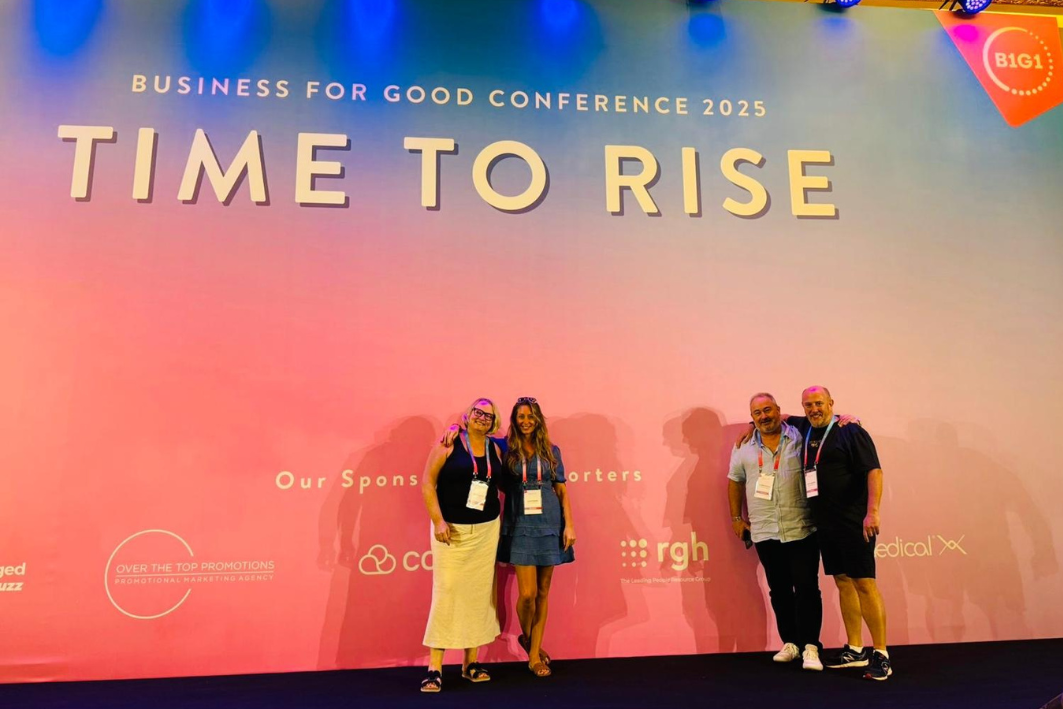
Date Posted: 23 November, 2025During November, four senior leaders from RGH attended the B1G1 Global Conference in Bali. Representing the Group were Justin Madgwick (Global CEO & Founder), Conrad Swailes (Global MD & Co-Founder), Laura Madgwick (Global Head of People & Culture) and Yasmin Brown (Head of Marketing & ESG).
The conference brought together international business leaders focused on integrating measurable social impact into commercial activity. The emphasis was not on philanthropy as a separate function, but on how impact can be embedded within operational and financial structures in a disciplined and accountable way.
For RGH, this approach is directly relevant. As a global people-resource group operating across recruitment, executive search, workforce optimisation and advisory services, our core activity influences workforce mobility, organisational culture and long-term career outcomes. Commercial growth, therefore, carries broader responsibility.
A consistent theme throughout the conference was that impact must be structured rather than symbolic. Businesses that treat giving as peripheral often struggle to demonstrate credibility. By contrast, organisations that link commercial performance to measurable social contribution create clearer alignment between purpose and profit.
The discussions also addressed leadership in the context of accelerating technological change. Contributors including Craig Mansell emphasised that successful AI adoption depends less on the technology itself and more on leadership behaviour. Transparency, accountability and meaningful support for teams navigating change were identified as critical factors. For organisations investing in workforce data and optimisation, alignment between technology strategy and organisational culture is essential.
A practical illustration of embedded impact came during a field visit to the John Fawcett Foundation in Bali. The Foundation operates mobile eye clinics providing cataract surgeries and vision screening to rural communities. Cataracts are medically treatable; however, for many individuals, access and affordability remain significant barriers. The Foundation has facilitated more than 55,000 free cataract surgeries and over one million eye screenings, demonstrating how structured operational delivery can produce direct and measurable social benefit.

Observing this work reinforced a key principle: impact is most effective when it is operationally integrated. It requires systems, measurement, consistency and long-term commitment rather than isolated initiatives.
For RGH, participation in the conference did not represent a shift in direction, but a reinforcement of existing strategy. Through our partnership with B1G1, social impact is linked directly to commercial performance across the Group. As activity grows, so does measurable giving. This approach ensures accountability and transparency while aligning impact with business expansion.
As we continue to scale internationally, our focus remains on disciplined growth. Sustainable performance is strengthened when organisations align financial outcomes with responsible leadership, workforce integrity and measurable contribution to communities.
The Bali conference provided an opportunity to review this alignment at a strategic level. It reaffirmed that impact, when embedded within commercial frameworks, enhances long-term resilience and credibility.
For organisations seeking to integrate measurable social impact into their commercial strategy, the question is not whether it is possible, but how it is structured.
We welcome conversations with partners, investors and business leaders who are exploring how growth, workforce strategy and responsible leadership can operate as a single, aligned model. Long-term value is built not only on what a business achieves, but on how it achieves it.
If you would like to know more contact us here.